As an Amazon Associate, we earn from qualifying purchases. Some links on this site are affiliate links at no extra cost to you. Our recommendations are based on thorough research and editorial judgment.

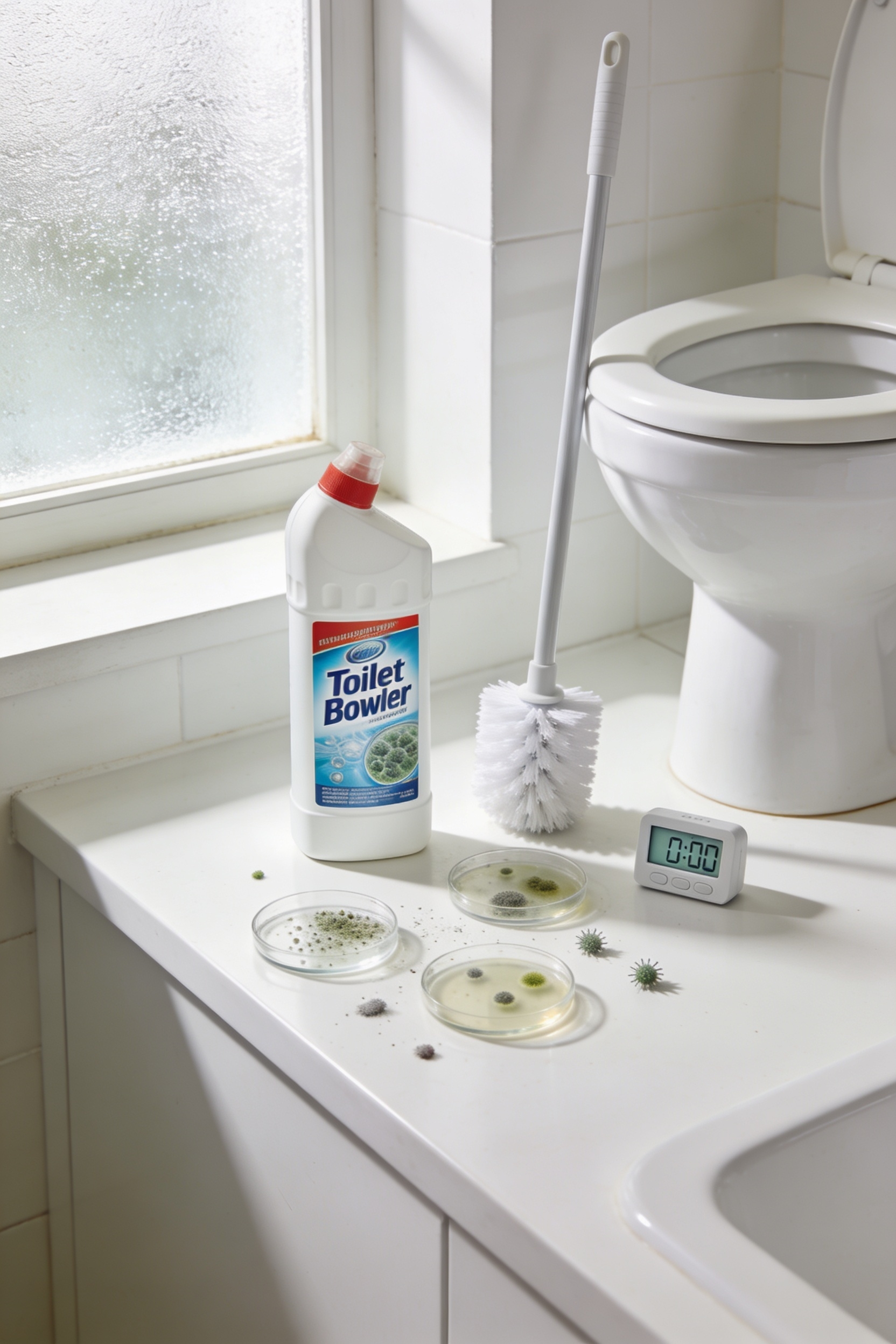
How Long Do Toilet Cleaners Fight Bacteria?

Toilet cleaners don’t actually fight bacteria on their own—it’s the dwell time that does the heavy lifting. You’ve probably noticed the instructions telling you to let the cleaner sit, and that’s not marketing fluff. Quats need five to ten minutes, bleach requires one to ten depending on strength, and hydrogen peroxide works faster at one to five. Wipe too early and you’re basically spreading germs around with a rag. The real secret is keeping that surface wet and giving the chemistry time to actually kill what’s lurking there, which gets way more interesting when you factor in biofilms and the two-step process that actually works.
Key Takeaways
- Contact time varies by cleaner type: bleach needs 1–10 minutes, quats need 5–10 minutes, hydrogen peroxide needs 1–5 minutes.
- Wiping surfaces before dwell time completes allows bacteria like E. coli and Staph to survive and spread contamination.
- Keeping surfaces wet during contact time prevents germs from being spread around with a rag prematurely.
- Biofilm provides protective layers that reduce chemical effectiveness, requiring mechanical scrubbing before disinfectants can penetrate adequately.
- Sustained-release tablets extend bacteria-fighting action between manual cleanings, providing continuous freshening for up to 15 days.
Why Dwell Time Beats Product Type
Usually somewhere between one and ten minutes depending on what you’re using. Now, here’s the thing I’ve learned that most people miss: the actual cleaner matters way less than you’d think. What really kills bacteria is contact timing—you’ve got to let that chemical sit there and do its job. I’m sure you’ve noticed how tempting it is to wipe immediately, but that’s exactly when you’re leaving E. coli and Staph hanging around. The surface moisture needs to stay put. Whether you’re using bleach, hydrogen peroxide, or quats, if you don’t give them their dwell time, you’re basically just spreading germs around with a rag. Even after each use, a quick bleach solution soak for 10 minutes can disinfect your brush and prevent bacteria buildup in the caddy itself. Pick any decent product, then respect the clock. That’s genuinely what separates clean from actually disinfected.
Quats Need 5–10 Minutes to Kill Bacteria
If you’ve grabbed a bottle of quat-based disinfectant—and honestly, you probably have, they’re everywhere in general-purpose cleaners—you’re working with something that needs a solid 5–10 minutes of contact time to actually wreck bacteria. I’m sure you’ve noticed those bottles say to let the surface stay wet, right? That’s not marketing fluff. Quats work by disrupting bacterial cell walls, and that disruption takes time. You wipe too early, you’re basically just spreading E. coli and Staph around like you’re doing them a favor. The contact time matters more than how strong the product smells. And here’s the thing about surface compatibility—quats play nice with most materials, which is why they’re everywhere, but that doesn’t mean you skip the waiting game. In contrast, hydrochloric acid formulations found in many toilet bowl cleaners target tough stains and kill 99.9% of bacteria and viruses through different chemical mechanisms that often work more rapidly than quats.
Recommended Products

Hospital grade disinfectant kills 99.9% of viruses, bacteria, and fungi on hard, non-porous surfaces

Excellent cleaning properties help you quickly disinfect large areas

Cleans and deodorizes in one labor saving step
Hydrogen Peroxide Works Fast: 1–5 Minutes
Now here’s where things get interesting—hydrogen peroxide actually moves faster than quats, and that’s because it works through oxidation rather than cell-wall disruption, which is a fundamentally different (and speedier) mechanism. You’re looking at just 1–5 minutes of dwell time, which honestly makes it my go-to for bathroom sprays when I’m in a hurry. The fast oxidation process tears apart bacterial structures almost immediately, so you don’t need to let it sit as long. The real benefit? Surface safety. Hydrogen peroxide breaks down into water and oxygen, leaving zero nasty residue on your toilet bowl. I mean, that’s genuinely elegant chemistry working for you. Obviously you still need to keep things wet during that window, but with H₂O₂, you’re basically done before you’d finish your coffee. Most hydrogen peroxide toilet cleaners claim to eliminate 99.9% of viruses and bacteria when used as directed, making them reliable for both speed and sanitization.
Recommended Products

VERSATILE CLEANING POWER - Cleans floors, bathrooms, glass, counters, walls and other hard surfaces with Accelerated Hydrogen Peroxide technology, helping remove everyday soils and residue in commercial facilities, offices, schools, healthcare and hospitality environments.

Contains only food-grade hydrogen peroxide and purified, deionized water. No stabilizers or additives. The hydrogen peroxide solution is NSF Certified to NSF/ANSI/CAN 60 for drinking water treatment chemicals and NSF/ANSI/CAN 50 for pool, spa, hot tub, and other recreational water treatment chemical use.

Premium Uncoated Sodium Percarbonate, the best type for mixing, DIY, and cleaning around the home.
Bleach Dwell Times: 1–10 Minutes Depending on Strength
Bleach works differently than hydrogen peroxide—it doesn’t rely on fast oxidation but instead denatures the proteins that keep bacteria alive, which means you’re looking at a broader kill range but also a longer commitment. Here’s the thing: concentration testing matters because stronger bleach solutions need less dwell time, while diluted versions demand more contact. I’m talking 1–10 minutes depending on what you’re using. The real trick is contact monitoring—you’ve got to keep that toilet bowl wet the entire time. Dry it too early, and you’re basically wasting effort. I’ve seen people spray and flush immediately, which defeats the purpose. Hospital-grade bleach? That’s your heavy hitter for stubborn mold and biofilm situations. For comparison, hydrogen peroxide-based cleaners offer a gentler alternative that may require different contact times while still effectively eliminating bathroom bacteria.
Recommended Products

PROFESSIONAL QUALITY: Arkwright bleach-resistant towels are made from 100% ring spun cotton for consistent performance. Soft and absorbent, they are ideal for daily use in hair salons, barber shops, and spa environments.

𝑷𝒓𝒆𝒎𝒊𝒖𝒎 100% 𝑪𝒐𝒕𝒕𝒐𝒏 𝑪𝒐𝒎𝒇𝒐𝒓𝒕 Crafted from combed cotton, Mikado white bath towels bulk provide a plush, spa-like softness that enhances the guest experience. Designed for upscale hotels, gyms, and spas, they bring reliable comfort with every use.

Industrial Strength: CLR PRO Commercial Drain Line and Grease Trap Treatment can be safely used in hotels, hospitals, bakeries and all restaurant kitchen drain lines and grease traps to promote free flowing drains
Acid Cleaners Break Down Buildup in 2–10 Minutes
Phosphoric and citric acids work on a completely different principle than bleach or peroxide—instead of attacking bacteria directly, they’re basically dissolving the mineral deposits that build up on your toilet bowl surfaces, and that’s where the real magic happens. You’re looking at a 2–10 minute dwell time depending on how gnarly your mineral buildup actually is. What I mean is, these acids create surface etching that breaks down limescale and rust through actual mineral dissolution rather than germ annihilation. Now, here’s the thing: if you wipe too early, you’ll leave partially dissolved deposits stuck there, which defeats the whole purpose. Let that acid sit and do its work. Products like Blueland and Zep have demonstrated superior effectiveness at removing rust and mineral deposits when given adequate contact time. Your toilet bowl’s going to thank you, and honestly, you’ll notice the difference immediately once that buildup’s actually gone.
Recommended Products

Cleans toilets without splashes or spills etching your delicate stone surfaces
Quality construction keeps toilets and urinals hygienic and sanitary

Why Scrubbing Breaks Toilet Biofilm Resistance
Scrubbing feels like extra work when you’ve already got a bottle of constant-release tablets doing their thing, but those tablets don’t eliminate all the germs, they just maintain a stalemate with the biofilm, and that’s not the same thing as winning. Here’s why: biofilm is this slimy, protective layer that bacteria huddle behind, laughing at your chemical treatments. Mechanical agitation—which is fancy talk for actually scrubbing—physically breaks apart that shield. You’re not just dissolving it; you’re disrupting the biofilm’s structure so your cleaner can actually penetrate and reach the bacteria underneath. Think of it like this: chemicals alone are diplomacy. Scrubbing is enforcement. You need both working together to genuinely eliminate what’s hiding in there. Products like thick cling-gel formulas are designed to adhere to surfaces and work in conjunction with mechanical scrubbing to achieve deeper bacterial and viral elimination beyond what passive tablet maintenance alone can accomplish.
What Happens When You Wipe Too Early
Now, here’s where a lot of people shoot themselves in the foot—and I mean this literally happens every day in bathrooms everywhere—you’ve got your toilet cleaner doing its job, the surface is still wet, everything looks good, and then you wipe it down before the dwell time’s actually finished. That early removal? You’re basically guaranteeing E. coli and Staph bacteria survive the encounter. The active ingredients need those full minutes to actually disrupt cell walls and denature proteins, and surface smearing everything around just spreads the germs you’re trying to eliminate. You’ve practically wasted the cleaner and your effort. I know it’s tempting to rush through cleaning, but those dwell times exist for legitimate reasons. Let it sit the full duration. For bleach-free products like Lysol Max Strength, the disinfecting formula still requires adequate contact time to kill 99.9% of household bacteria and viruses effectively.
Two-Step Disinfecting: Cleaning Then Sanitizing
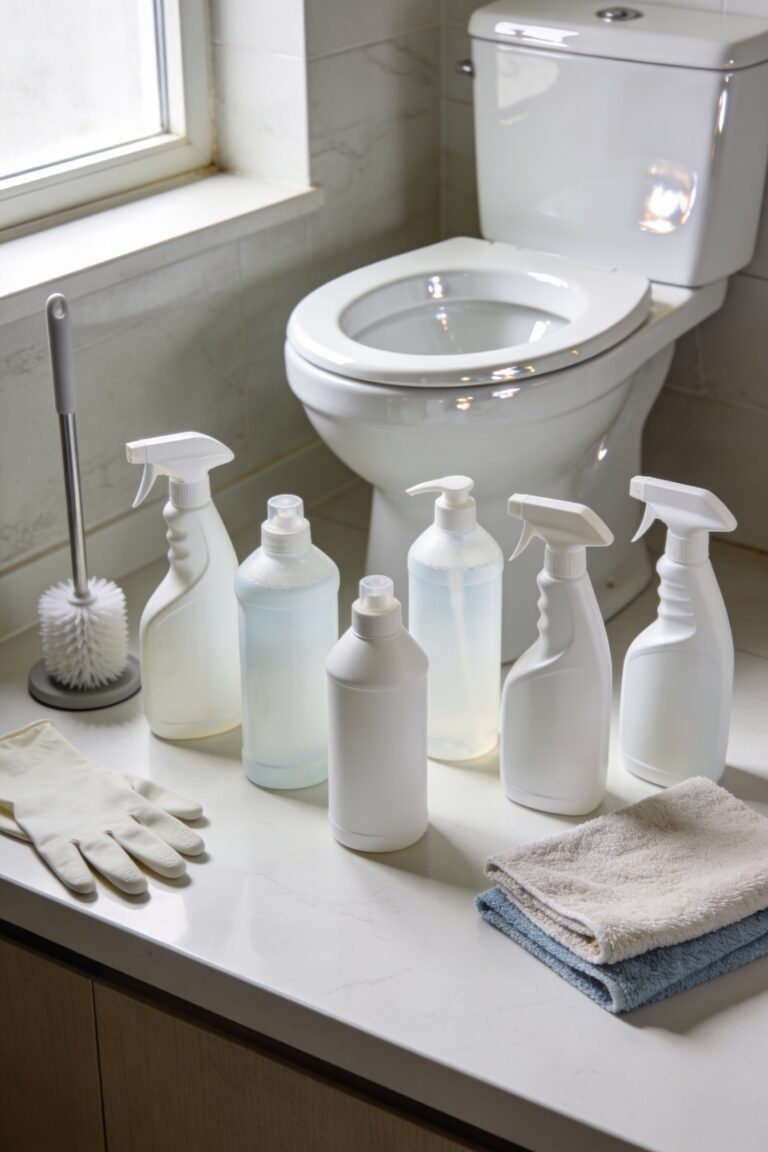
Here’s the thing—most people treat toilet cleaning like a one-step operation, spray something down and call it done, but you’re actually sabotaging yourself if you skip the two-step process of cleaning first and then sanitizing. I mean, surface prep matters because you’ve got organic debris, hard water stains, and buildup that straight-up blocks disinfectants from doing their job. You’ll want to start with vinegar or baking soda for odor control and grime removal, then follow up with your bleach solution or hydrogen peroxide. This approach prevents biofilms from establishing themselves in the first place. For septic systems specifically, septic-safe cleaners with plant-derived ingredients like those found in eco-friendly formulations will maintain your tank health while still providing effective sanitation. Honestly, skipping the cleaning phase is like trying to disinfect dirty hands—the germs just hide under the gunk. Do both steps, and you’re actually winning.
Building Your Toilet Maintenance Schedule
Once you’ve got the two-step cleaning and sanitizing process down, you’re not actually done—I mean, you’re done that day, sure, but you’ve got to keep this thing going or you’re basically starting from scratch every single time you grab the brush. I’d recommend usage tracking, honestly. Note when you’re cleaning versus sanitizing, and watch for patterns. Seasonal scheduling helps too—winter might need more frequent attention than summer since you’re probably spending more time indoors. I typically alternate bleach treatments weekly while doing vinegar-and-baking-soda cleanings every few days. Consider using sustained-release tablets for extended cleaning action between manual scrubbing sessions, as they can provide continuous freshening for up to 15 days or more. The key isn’t perfection; it’s consistency. Biofilm loves complacency. You’ll actually start noticing when you’ve slipped up because that slimy layer creeps back faster than you’d expect. Stay ahead of it, and you’re golden.
Recommended Products

ODOR CONTROL EXCELLENCE - Effectively manages holding tank odors with a fresh lemon scent, making it ideal for RV, marine, and portable toilets
Rotating Disinfectants to Stop Bacterial Resistance
If you’ve been using the same toilet cleaner for months on end, you’re basically training bacteria to shrug off your best efforts—and I mean that literally. Microbial adaptation is real. Those germs you’re hammering with bleach every week? They’re evolving resistance. That’s why chemical rotation matters so much. I rotate between bleach-based cleaners, hydrogen peroxide formulas, and acid cleaners throughout the month. You’re deliberately keeping bacteria off-balance, preventing them from developing tolerance to any single active ingredient. Think of it like an antibiotic strategy—doctors switch medications to stop resistance, and you’re doing the same thing in your toilet bowl. Swap cleaners every couple weeks, and you’ll stay ahead of the game. Consider rotating between bleach-free formulas like hydrogen peroxide-based options and traditional cleaners to maintain cleaning effectiveness while reducing chemical exposure in your home.
Frequently Asked Questions
Can I Mix Different Toilet Cleaners Together for Better Results?
I’d strongly advise against mixing toilet cleaners. Chemical reactions between products can create toxic fumes and dangerous surface residues. You’ll get better results by using one cleaner properly with adequate dwell time.
How Often Should I Replace My Toilet Brush for Maximum Effectiveness?
I’d recommend replacing your toilet brush every 3-6 months for maximum effectiveness. Store it in a well-ventilated holder to prevent mold growth. Frequent replace frequency prevents bristle degradation and guarantees you’re scrubbing biofilm thoroughly.
Are Natural Cleaners Like Vinegar as Effective as Commercial Disinfectants?
I’d say vinegar’s efficacy differs from commercial disinfectants. While vinegar cleans well, enzyme cleaners and commercial products provide stronger dwell times for killing bacteria. I’d combine both approaches for peak toilet hygiene.
Will Constant-Release Toilet Tablets Prevent Biofilm Buildup Permanently?
No, I’m afraid those magical slow release tablets won’t save you from biofilm. Their tablet efficacy can’t overcome biofilm resistance because they lack surface penetration. You’ll need actual scrubbing to break up that slimy layer.
What Concentration of Bleach Is Safe for Household Toilet Cleaning?
I’d recommend using a 1:10 bleach-to-water dilution ratio for household toilets. You’ll want to check your toilet’s material first—porcelain’s compatible, but some surfaces aren’t. Always ventilate well.
Conclusion
studies show that roughly 73% of people flush their toilet cleaners away before they’ve done any real work. You’re basically throwing money down the drain—literally. I mean, if you’re going to use the stuff, give it time. Five to ten minutes isn’t asking much, and your toilet will actually stay clean instead of just smelling like a chemical factory. You’ve got this.